

For many founders, one of the first questions is simple: How much will it cost to create an MVP?
However, this question is often formulated incorrectly. The real challenge here is to maximize the return on every dollar invested before the product meets market requirements.
The startup ecosystem provides plenty of evidence that cost overruns are expensive. According to CB Insights’ analysis of 431 venture-backed startup failures, 43% of failed startups cited product inconsistency with the market as the main reason for failure, while 70% eventually ran out of capital. It is important to note that the report says that lack of money is often a consequence rather than the root cause. Many companies exhaust their financial resources because they develop products that are not in sufficient demand on the market.
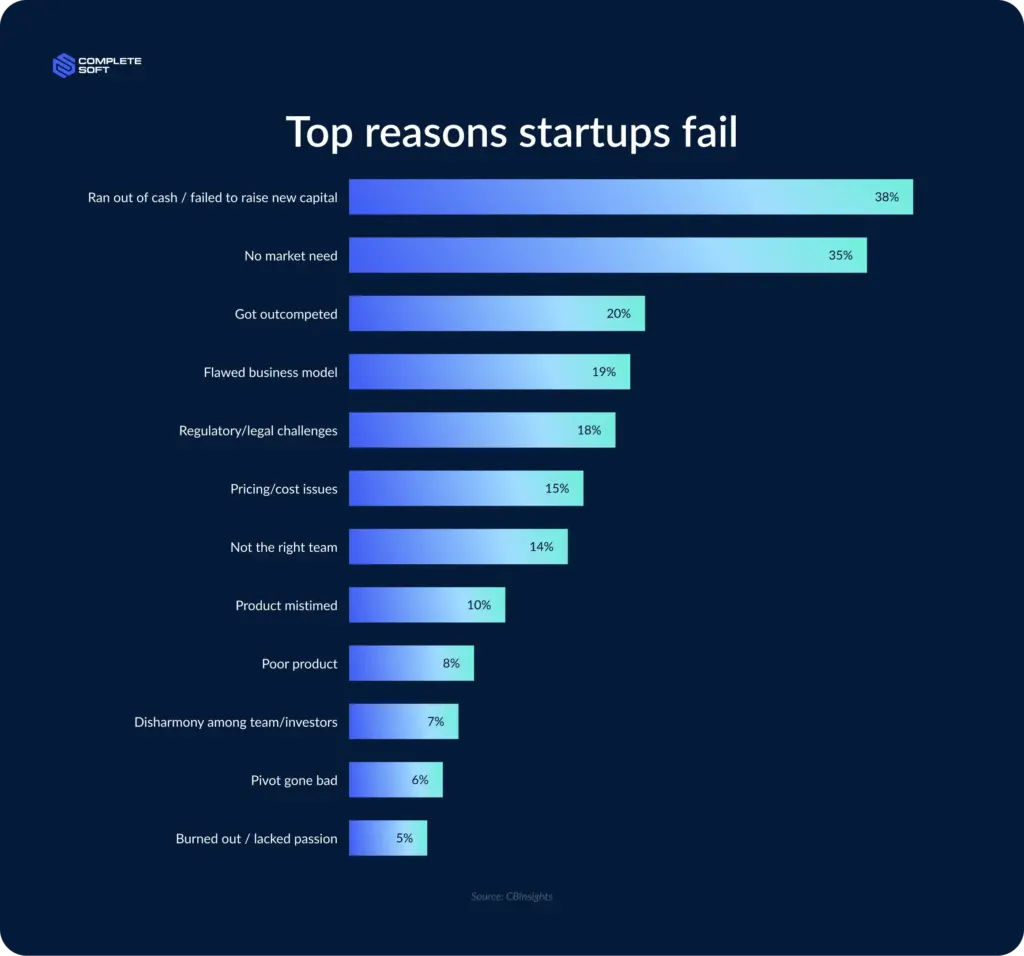
In other words, the biggest financial risk for early-stage founders is not necessarily building too little. Building too much before proving that customers actually want the product is an issue as well.
Early validation signals such as customer interviews, waitlists, pre-orders, pilot users, and initial revenue are often considered stronger indicators of market demand than a large feature set.
Therefore, the cost of building an MVP in 2026 can range from a few thousand dollars for a validation-focused product to well over six figures for a complex AI platform.
In this blog article, we examine the average cost of MVP development in 2026, the factors that influence pricing, and the hidden expenses many founders overlook.
What is an MVP?
The term Minimum Viable Product first gained widespread recognition through Eric Ries’s Lean Startup methodology. According to Ries, an MVP is the simplest (but not necessarily the smallest) version of a product that allows a team to test a business hypothesis with real users.
This distinction matters because many founders still treat an MVP as a cheaper version of the final product. But a full-scale product aims to support growth and retention at scale. In turn, an MVP helps founders determine whether a problem is worth solving before they commit substantial resources.
Several well-known technology companies followed this path. Before Airbnb became a global marketplace, its founders tested the concept with a simple website that allowed guests to book accommodation in their apartment during a design conference in San Francisco. Likewise, Dropbox validated demand through a short product demonstration video before significant investments.
What is the average MVP development cost in 2026?
MVP pricing largely depends on three factors: product complexity, the amount of custom development, and the level of uncertainty the product must address.
To provide a realistic benchmark, the table below summarizes average MVP development costs in 2026.
| MVP type | Estimated cost |
| Landing Page MVP | $1,000–5,000 |
| No-Code MVP | $3,000–15,000 |
| Prototype MVP | $2,000–10,000 |
| Web App MVP | $15,000–80,000+ |
| Mobile App MVP | $20,000–120,000+ |
| AI MVP | $25,000–150,000+ |
These figures reflect current market rates across North America and Europe. Actual costs may differ based on team location, project scope, and technical requirements.
What affects MVP development cost?
Even though industry averages provide useful reference points, they rarely help founders estimate the cost of their own product. Two startups may build MVPs within the same market category and still face completely different budgets.
And the following factors have the greatest impact on MVP development costs.
Product complexity
A basic task management application may require user registration, a dashboard, and a few core workflows. Such functionality is relatively straightforward to implement.
By contrast, a fintech platform that processes payments, verifies identities, manages transactions, and complies with regulatory requirements demands a much larger investment. Healthcare products face similar challenges because they often require enhanced security, compliance measures, and sophisticated data management.
Therefore, two products with a similar number of screens can have very different budgets.
Feature scope
At an early stage, it is tempting to include every idea that appears valuable. But keep in mind that, each feature increases development time, testing requirements, and future maintenance costs.
For example, a project may start with a simple objective:
- User registration
- Profile management
- Basic search
- Messaging
Then additional requests emerge:
- Social login
- Recommendation engine
- Advanced analytics
- Multi-language support
- Notification system
- Admin dashboard
Individually, each feature may seem reasonable. Collectively, they can double or triple the budget.
Technology stack
No-code and low-code platforms generally offer the lowest entry cost. For products that focus on validation, these tools can accelerate time to market considerably.
Custom software development requires a larger budget. However, it provides greater flexibility, ownership, and scalability.
AI-powered products introduce another layer of complexity. Beyond application development, teams often need:
- Model integrations
- Data processing pipelines
- Vector databases
- Monitoring systems
- Security controls
Platform choice
A web application typically requires a single codebase and one user experience. This structure reduces implementation effort.
A mobile product introduces additional considerations. Teams must account for device compatibility, operating system requirements, application store submissions, and platform-specific design conventions.
When founders choose to launch on both iOS and Android simultaneously, costs increase further.
For this reason, many startups begin with one platform. After they validate demand, they expand to additional platforms based on user feedback and business priorities.
Third-party integrations
Most MVPs rely on external services to deliver critical functionality. Common integrations include:
- Stripe for payments
- OpenAI for AI capabilities
- Twilio for messaging
- Google Maps for location services
- HubSpot or Salesforce for CRM functionality
These integrations can reduce development time because teams avoid building complex systems from scratch. On the other hand, they introduce implementation costs, subscription fees, and potential maintenance requirements.
What are hidden costs founders often overlook?
These expenses may not appear in the initial proposal, yet they can significantly affect the total cost of ownership.
Product discovery
Before a team writes a single line of code, it must define user needs, business objectives, core assumptions, and feature priorities. Without this foundation, development teams frequently build functionality that users neither need nor value.
Therefore, product discovery should not be viewed as an optional expense.
Quality assurance and testing
Every feature requires verification across different devices, browsers, operating systems, and user scenarios. Without proper testing, defects reach production and create additional costs after launch.
Moreover, software bugs become more expensive to fix as development progresses. According to IBM’s widely cited Systems Sciences Institute research, defects identified after release can cost significantly more to resolve than issues discovered during earlier development stages.
Infrastructure and cloud services
Cloud infrastructure has lowered barriers to entry for startups. Nevertheless, cloud services are not free.
Even a relatively simple MVP may require:
- Application hosting
- Databases
- File storage
- Monitoring tools
- Security services
- Backup systems
Initially, these costs may remain modest. As user activity grows, however, infrastructure expenses often increase faster than founders expect.
Third-party software and APIs
Modern products frequently depend on external services.
For example, startups often integrate:
- OpenAI APIs
- Stripe payment infrastructure
- Twilio communication services
- Analytics platforms
- Authentication providers
While these tools reduce development effort, they introduce recurring operational expenses. A founder may initially budget for development but overlook monthly platform fees. Once user adoption increases, these costs can become substantial.
Maintenance and support
After release, teams typically address bug reports, security updates, infrastructure issues, user feedback, and feature improvements. Furthermore, third-party integrations, operating systems, and cloud services evolve continuously.
Industry estimates often place annual software maintenance costs between 15% and 25% of the original development budget, although actual figures vary by product complexity and growth stage.
Technical debt
Technical debt represents one of the least visible yet most expensive risks in software development.
In order to launch quickly, teams sometimes implement temporary solutions, shortcuts, or architectural compromises. While these decisions may accelerate delivery, they often create future challenges.
Conclusion
The cost of building an MVP in 2026 can range from a few thousand dollars to over six figures. However, the final budget depends less on the type of product and more on the decisions founders make during the planning stage.
If you’re evaluating a startup idea and want to understand its development costs, the CompleteSoft team can help.
We work with founders to define MVP scope, prioritize features, select the right technology stack, and create realistic development roadmaps based on business goals rather than assumptions. Contact CompleteSoft for a free MVP consultation and cost estimate.