

In modern product development, teams rarely choose between “good” and “bad” approaches. Instead, they choose between different types of trade-offs: speed versus flexibility, short-term efficiency versus long-term control, and abstraction versus transparency.
No-code and low-code platforms sit on one side of this spectrum, offering a faster way to build applications by abstracting away much of the underlying engineering effort. Traditional development sits on the other side, requiring more time upfront but offering full control over architecture, performance, and long-term evolution.
The real challenge is to understand when each one is actually the right tool for the job.
The core difference is not speed – it is control over complexity
At a surface level, no-code and low-code platforms are attractive because they reduce the amount of code that needs to be written. This typically means faster delivery and lower initial costs.
However, from an engineering perspective, the more important difference is how complexity is handled over time.
Traditional development makes complexity explicit. You define architecture, data models, system boundaries, and integrations directly in code. This requires more effort initially, but it also means the system can evolve in any direction as requirements change.
Low-code and no-code systems, on the other hand, manage complexity through abstraction. This makes early development significantly faster, but also introduces boundaries that are defined by the platform itself rather than the engineering team.
This distinction becomes critical when systems move beyond simple use cases.
When no-code actually makes sense
No-code tools are often misunderstood as “simplified development”, but in reality they are best viewed as business automation environments rather than full software engineering platforms.
They tend to work extremely well in situations where the problem space is stable and relatively simple. For example, internal dashboards, approval workflows, simple CRUD applications, or operational tools that support existing processes.
In these cases, the goal is not to design a highly scalable system, but to reduce manual effort and eliminate repetitive engineering work.
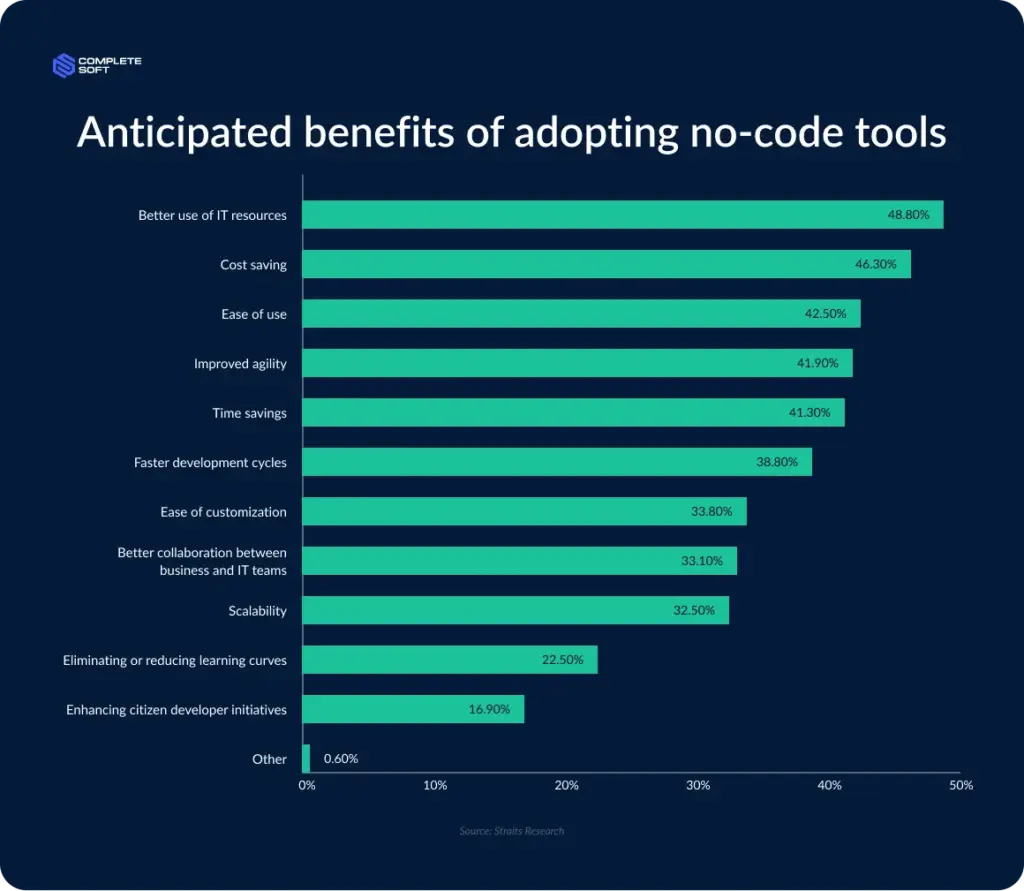
This is also why no-code adoption is particularly strong in early-stage product validation. Research on startup usage patterns shows that teams often use no-code tools to quickly test ideas and validate assumptions before investing in full engineering infrastructure.
In this context, no-code is not a replacement for engineering. It can be a temporary acceleration layer for experimentation.
However, the same research also shows a recurring pattern: once products gain traction and requirements become more complex, teams frequently migrate away from no-code systems due to scalability and integration limitations.
Where low-code fits in the middle
Low-code sits between no-code and traditional development. It allows for visual development while still enabling custom code when needed.
This makes it particularly useful in enterprise environments where there is a high demand for internal applications but limited engineering capacity.

Large organizations such as Siemens and Schneider Electric have publicly documented their use of low-code platforms like Mendix and OutSystems to accelerate internal application delivery. In these cases, the primary benefit is not eliminating development work, but redistributing it — allowing business-facing teams to build solutions while engineering teams focus on core systems.
For example, Schneider Electric reported significant productivity gains and operational efficiency improvements through OutSystems, with independent analysis by Forrester estimating a 506% ROI over three years and rapid payback periods in enterprise deploymentsю
However, what is important in these cases is the type of systems being built. Low-code performs best when applications are internal, workflow-driven, and structurally consistent.
As complexity increases — especially in systems that require deep customization, high-performance constraints, or complex domain logic — the abstraction layer begins to impose limitations.
At that point, development is no longer only about building features, but about working within the boundaries of the platform.
When traditional development becomes necessary
Traditional software development becomes essential when systems are expected to evolve continuously, integrate deeply with other systems, or handle complex and unpredictable business logic.
Unlike low-code and no-code approaches, traditional development does not impose architectural constraints beyond those chosen by the engineering team. This allows full control over performance, scalability, security, and system design.
This flexibility becomes particularly important in core product systems — the parts of the software that directly generate revenue or define competitive advantage.
It is also important in environments where long-term maintainability matters more than initial speed. While low-code platforms can significantly reduce time-to-market, they also introduce dependency on platform-specific abstractions. Over time, this can make migration or deep refactoring significantly more expensive than in traditional codebases.
The real decision is not tool-based – it is lifecycle-based
Rather than thinking in terms of “which approach is better”, it is more accurate to think in terms of system lifecycle.
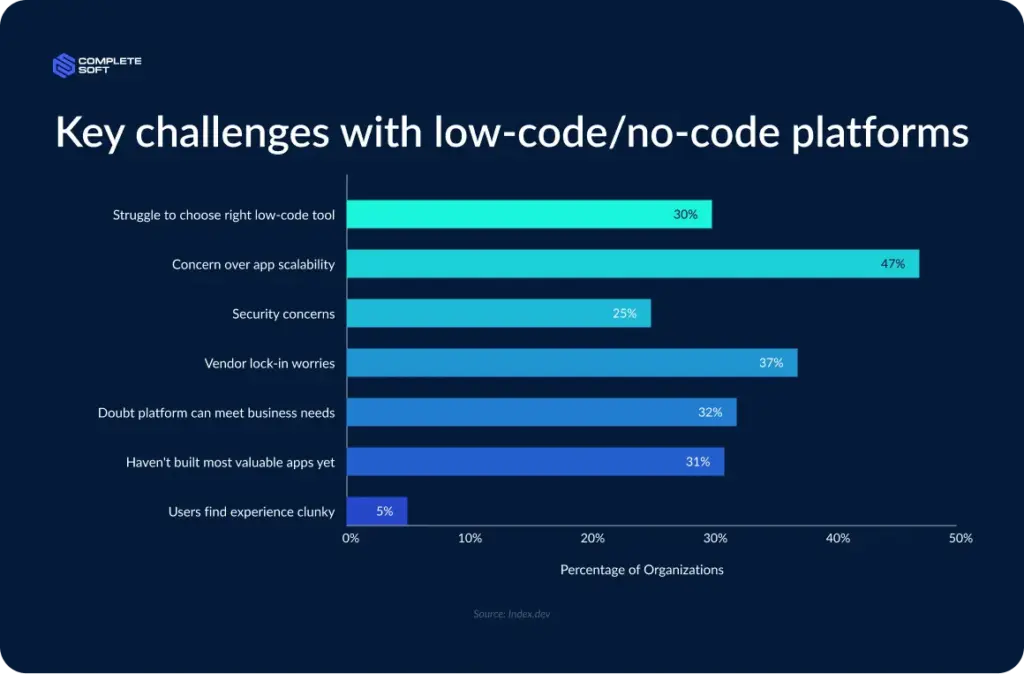
No-code tends to be most effective at the very beginning of a product lifecycle, where speed and validation matter more than architecture.
Low-code tends to sit in the middle phase, where systems need to scale operationally but remain relatively bounded in complexity.
Traditional development becomes dominant in mature systems, where long-term flexibility, integration depth, and architectural control are critical.
This creates a natural progression: early experimentation → structured scaling → long-term engineering ownership
Each stage benefits from a different level of abstraction.
| Lifecycle stage | No-code | Low-code | Traditional development |
| Idea / Validation | Excellent for rapid prototyping and testing assumptions | Good, but often unnecessary overhead | Slower initial validation |
| Early Product | Fast MVP delivery, minimal engineering effort | Strong balance of speed and structure | Higher effort but maximum flexibility |
| Growth Phase | Becomes limiting as complexity increases | Effective but may hit platform constraints | Scales naturally with architecture evolution |
| Mature System | Typically unsuitable for core systems | Works for bounded internal systems | Best suited for core, complex systems |
| Long-term Evolution | High migration risk | Medium dependency risk | Full control over change and refactoring |
Conclusion: key takeaways
The most common misconception in discussions about no-code and low-code is that they are alternatives to traditional engineering. In reality, they are different layers of abstraction optimized for different stages of system maturity.
The key insights from real-world usage are:
- No-code is most effective for fast validation and simple internal tools, but struggles with long-term scalability.
- Low-code is well-suited for enterprise internal systems and structured workflows, but introduces platform dependency over time.
- Traditional development remains essential for systems where flexibility, scalability, and long-term evolution are core requirements.
- The most effective organizations do not choose one approach exclusively — they intentionally combine them across different parts of the system.
Ultimately, the decision is not about tools themselves, but about understanding the expected lifecycle of the product.
Because in software engineering, the most expensive mistake is not choosing the wrong tool — it is using the right tool in the wrong phase of evolution.
FAQ
Is no-code a replacement for software development?
No-code is not a replacement for software engineering. It is an abstraction layer designed to accelerate the creation of simple to moderately complex applications. In practice, it works best for prototypes, internal tools, and workflow automation. Once systems require deeper logic, integrations, or scalability, traditional development becomes necessary.
When should a company avoid low-code platforms?
Low-code should generally be avoided when the system is expected to become a core business product with long-term evolution requirements. While it can significantly reduce initial delivery time, it introduces platform dependency and limits architectural flexibility, especially in complex or highly customized domains.
Is low-code suitable for enterprise systems?
Yes, but with clear boundaries. Enterprises such as Siemens and Schneider Electric have successfully used low-code platforms for internal applications and workflow-heavy systems. However, these implementations are typically non-core systems, not the primary revenue-generating platforms. As system complexity increases, governance and long-term maintainability become key concerns.